
Sprained Ankle
Sprained Ankle


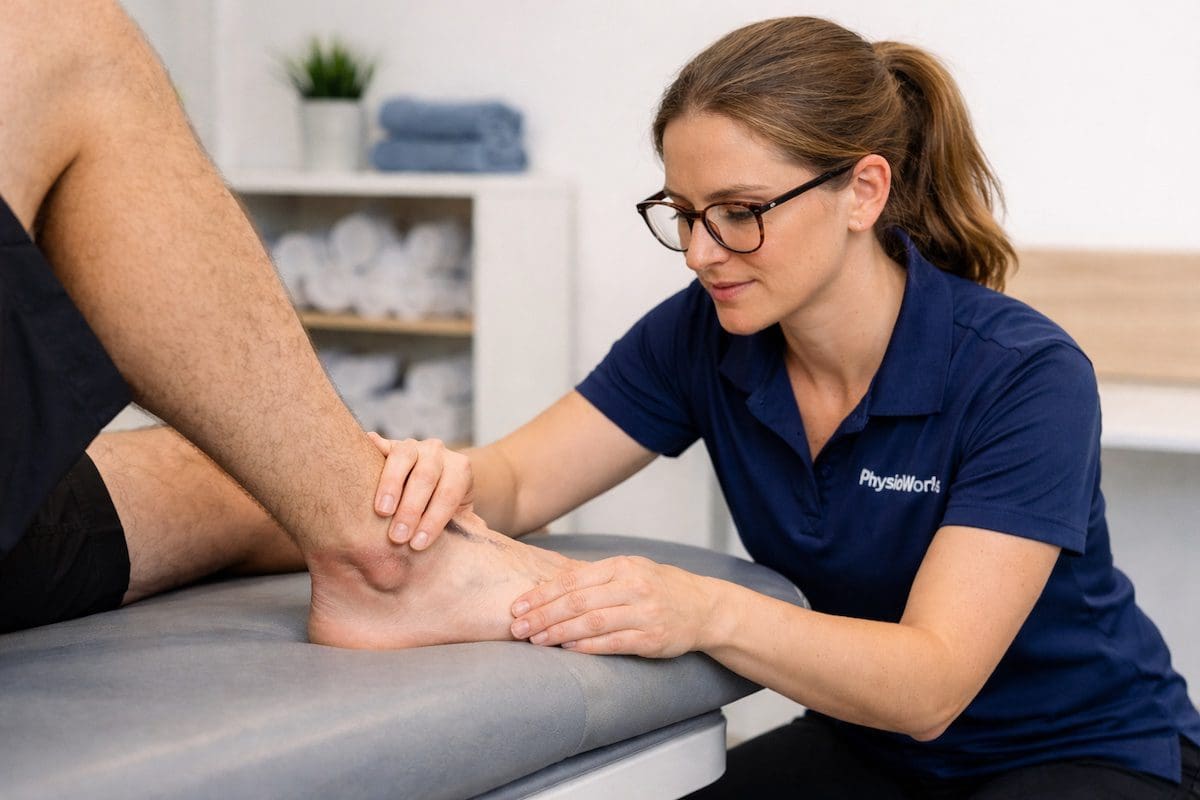
Physiotherapy assessment can help determine which ankle structures may have been injured and whether further investigation is appropriate.
A sprained ankle occurs when one or more ankle ligaments are stretched or torn, usually after the foot rolls inwards. Most ankle sprains involve the ligaments on the outside of the ankle. Pain, swelling, bruising and difficulty walking are common, but severity varies considerably.
Most common
The outer ankle ligaments are injured most often, particularly after the foot rolls inwards.
Assessment matters
Some injuries that look like ankle sprains involve a fracture, high ankle sprain or another joint injury.
Rehabilitation
Recovery involves more than waiting for pain to settle. Movement, strength, balance and confidence may all need rebuilding.
For a broader overview of ankle conditions, see our ankle pain and injury guide. You can also read Healthdirect’s ankle sprain information.
What Is a Sprained Ankle?
A sprained ankle happens when one or more ankle ligaments are stretched beyond their usual range or torn. Ligaments connect bones and help stabilise a joint.
The most common pattern is an inward roll of the foot. This places stress on the ligaments on the outside of the ankle and is known as a lateral ankle sprain.
Less commonly, the ligaments on the inside of the ankle may be injured. An injury to the ligaments connecting the tibia and fibula above the ankle is called a high ankle sprain or syndesmosis injury.
What Causes a Sprained Ankle?
An ankle sprain usually happens during a sudden twist, awkward landing, missed step or change of direction. It can occur during sport, running, hiking, work or ordinary daily activity.
Common situations include:
- landing awkwardly after a jump;
- stepping on an uneven surface;
- changing direction quickly;
- rolling the ankle during running or field sport;
- missing a step or kerb; and
- losing balance while the foot is planted.
A previous ankle sprain can also increase the likelihood of another injury, particularly when strength, balance or movement control has not fully recovered.
What Are the Symptoms of a Sprained Ankle?
Symptoms depend on which structures were injured and how severe the injury was. Common features include:
- pain around the outside or inside of the ankle;
- swelling around the joint;
- bruising that may spread into the foot;
- tenderness over injured ligaments;
- difficulty bearing weight or walking normally;
- reduced ankle movement; and
- a feeling that the ankle is unstable or may give way.
Some people hear or feel a pop when the injury occurs. A pop does not, by itself, confirm the severity or type of injury.
When Should You Seek Medical Care?
Seek urgent medical care if the foot becomes numb, unusually cold, pale or discoloured, or if the ankle or foot appears obviously deformed.
An X-ray is not required for every ankle sprain. A clinician can assess the injury and use recognised fracture-screening criteria to decide whether imaging may be appropriate.
If you are unsure whether the injury could be a fracture, see our ankle fracture guide.
Which Ligaments Are Usually Injured?
Most ankle sprains affect the lateral ligament complex on the outside of the ankle. These ligaments include:
- the anterior talofibular ligament;
- the calcaneofibular ligament; and
- the posterior talofibular ligament.
The anterior talofibular ligament is commonly affected during a typical inward ankle roll.
A high ankle sprain affects the syndesmosis between the tibia and fibula. These injuries can behave differently from a typical lateral ankle sprain and may require a slower progression back to higher loads.
How Is a Sprained Ankle Assessed?
Your physiotherapist or doctor will usually ask how the injury happened and how your symptoms have changed since then. Assessment may include checking:
- where the ankle is painful and tender;
- swelling and bruising;
- ankle and foot movement;
- your ability to stand and walk;
- ligament stability;
- strength and muscle control; and
- balance and functional movement.
Imaging may be considered when the examination suggests a fracture, syndesmosis injury, cartilage injury, significant tendon injury or another problem that needs clarification. Imaging may also be appropriate when recovery is not progressing as expected.
How Are Ankle Sprains Graded?
Ankle sprains are sometimes described as Grade I, II or III according to the amount of ligament damage and associated loss of function.
Grade I
A mild ligament injury. Walking may remain possible, although the ankle can be sore and swollen.
Grade II
A partial ligament tear. Swelling, bruising and limping are more common.
Grade III
A complete ligament tear with greater loss of function. Weight-bearing may be difficult.
The grade does not determine recovery time by itself. Walking ability, swelling, ankle movement, strength, balance, associated injuries and the demands of your work or sport also affect rehabilitation.
How Can Physiotherapy Help a Sprained Ankle?
Physiotherapy may help guide protection and loading after an ankle sprain, restore normal movement and walking, rebuild strength and balance, and prepare the ankle for work, running or sport.
Exercise-based rehabilitation is an important part of recovery and may reduce the risk of recurrent lateral ankle sprains.1
What Does Sprained Ankle Rehabilitation Involve?
Rehabilitation should progress according to your symptoms and function rather than a fixed timetable. The exact program depends on the injury, your normal activities and how the ankle responds to increasing load.
-
Protect the ankle and settle symptoms
Reduce repeated rolling and modify painful activity. A brace, taping or walking aid may be useful when clinically appropriate.
-
Restore comfortable movement and walking
Gradually regain ankle movement and progress weight-bearing as tolerated. The aim is to move towards a comfortable, more normal walking pattern.
-
Rebuild strength
Progress calf, ankle and whole-leg strength so the injured side can tolerate everyday and sporting loads.
-
Retrain balance and ankle control
Balance and sensorimotor exercises help restore control after an ankle sprain and are particularly relevant when the ankle continues to feel unstable.2
-
Prepare for work, running or sport
Later rehabilitation may include hopping, landing, running, acceleration, braking, change-of-direction drills and tasks specific to your work or sport.
Early Care and Support
During the early stage, relative rest and temporary activity modification may help control symptoms. Cold packs can be used for short-term comfort if they feel helpful, while compression and elevation may assist swelling management.
Complete rest is not usually the goal. As symptoms allow, appropriately progressed movement and weight-bearing help restore function.
Depending on the injury, short-term support may include ankle strapping, an ankle brace, crutches or, for selected injuries, a moon boot. The appropriate option depends on the injury and your ability to walk safely.
Restore Strength and Balance
As pain and swelling settle, rehabilitation can progress from ankle movement and simple strengthening towards more demanding calf, lower-limb and balance exercises.
Balance training can improve function in people with chronic ankle instability.2 Our balance training guide explains this area in more detail.
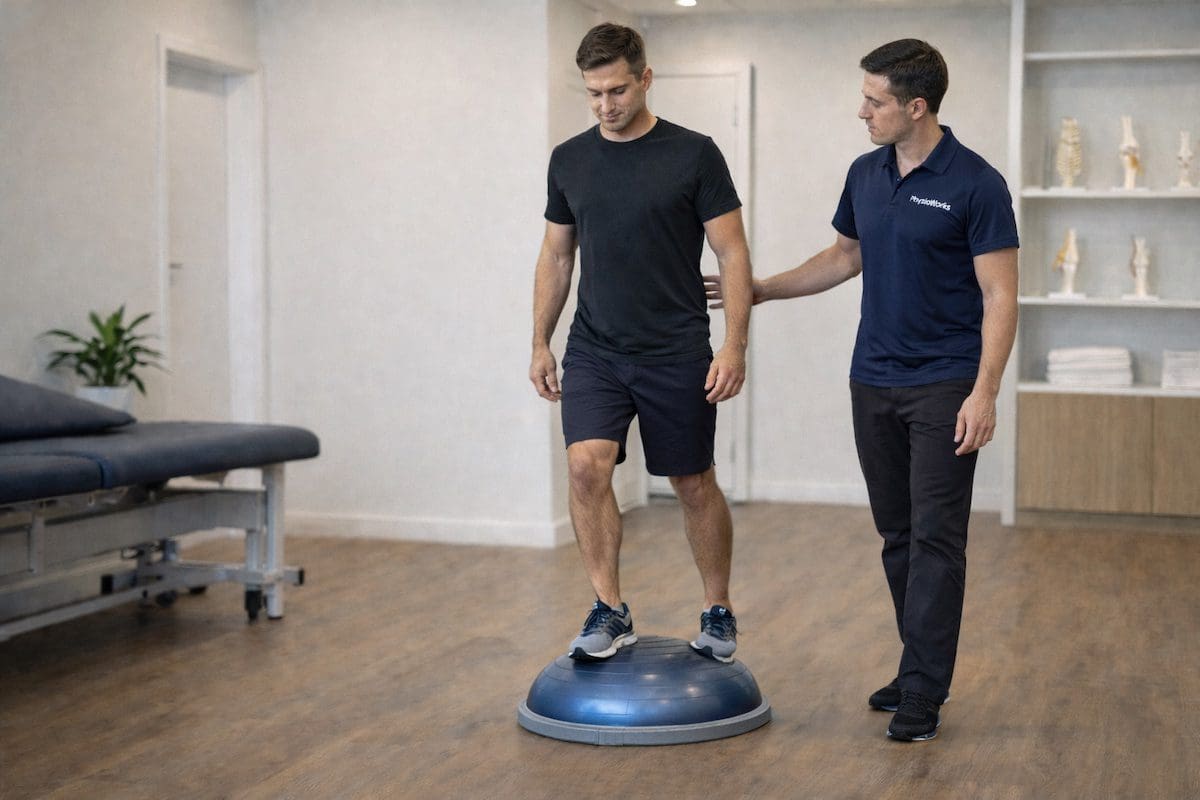
Balance and movement-control exercises can form part of progressive ankle rehabilitation.
When Can You Return to Running or Sport?
Return to sport should depend on how your ankle performs, not simply how many days have passed since the injury.
A physiotherapist may consider several areas before progressing you back to unrestricted sport:
Pain and swelling
Symptoms should remain acceptable during activity and afterwards.
Ankle function
Movement, strength, endurance and power should be appropriate for the activity you are returning to.
Confidence
The ankle should feel increasingly stable and trustworthy during demanding tasks.
Balance and control
Single-leg control and dynamic balance should cope with the movements required by your activity.
Sport performance
Hopping, jumping, agility and sport-specific drills may be assessed before full return.
Training tolerance
You should be able to tolerate an appropriate training load without a significant symptom flare.
This approach reflects the principles of the PAASS return-to-sport framework for acute lateral ankle sprain.4
Should You Keep Walking on a Sprained Ankle?
You do not need to prove that you can walk through substantial pain. If every step causes marked pain or a clear limp, reduce the load and consider assessment.
As symptoms allow, short periods of comfortable walking can form part of recovery. The aim is to increase weight-bearing progressively rather than either forcing painful walking or avoiding use of the ankle unnecessarily.
A brace, taping or crutches may make early walking safer or more comfortable for some injuries.
What If Your Sprained Ankle Does Not Settle?
An ankle that remains painful, swollen, stiff or unstable deserves reassessment. Persistent symptoms may occur because rehabilitation is incomplete, but another injury may also need consideration.
Possible contributors include:
- chronic ankle instability;
- a high ankle sprain;
- joint or cartilage irritation;
- ankle impingement;
- tendon injury;
- a missed fracture; or
- sinus tarsi syndrome.
Your physiotherapist may modify your rehabilitation or recommend medical review or imaging when the presentation warrants it.
How Can You Reduce the Risk of Another Ankle Sprain?
Feeling pain-free does not necessarily mean the ankle has regained its previous strength, balance and movement control. Completing rehabilitation can help reduce the risk of another ankle sprain.
Useful prevention strategies may include:
- continuing ankle and calf strengthening;
- maintaining balance and movement-control exercises;
- gradually rebuilding running, jumping and change-of-direction loads;
- using footwear suited to your activity;
- preparing properly before demanding sport; and
- using taping or an ankle brace in higher-risk sport when this is appropriate for you.
Read our ankle sprain prevention guide for more practical prevention strategies.
How Long Does a Sprained Ankle Take to Recover?
Recovery varies substantially. A mild ankle sprain may allow comfortable daily activity relatively quickly, while a more substantial ligament injury may require several weeks or longer before higher-level activity feels normal.
Severe lateral sprains and high ankle sprains can take considerably longer. Pain may also improve before strength, balance, power and confidence have fully recovered.
Sprained Ankle FAQs
How long does a sprained ankle take to heal?
Recovery varies with the ligament injury, associated damage and the demands you need to return to. Mild sprains may improve relatively quickly, while more substantial or high ankle sprains can take several weeks or months. Strength, balance and confidence may continue improving after pain has settled.
Should I walk on a sprained ankle?
Avoid forcing walking when every step causes substantial pain or a marked limp. As symptoms allow, comfortable weight-bearing and short walks can form part of recovery. Taping, a brace or crutches may help some people during the early stage.
Do I need an X-ray or scan for a sprained ankle?
Not every ankle sprain needs imaging. A clinician may recommend an X-ray when fracture screening indicates it, or other imaging when a high ankle sprain, cartilage injury, tendon injury or unexpectedly slow recovery needs further investigation.
Can a sprained ankle cause long-term problems?
Some people develop recurrent sprains, ongoing pain, stiffness or chronic ankle instability. Progressive rehabilitation that restores movement, strength, balance and activity-specific control may reduce these risks.
How can physiotherapy help a sprained ankle?
Physiotherapy may help assess the injury, guide protection and progressive loading, restore walking and ankle movement, rebuild strength and balance, and plan a graded return to work, running or sport.
What To Do Next
If you have recently rolled your ankle, protect it from another significant twist and adjust activities that are causing substantial pain or swelling.
Book an assessment if walking remains difficult, you are unsure about the severity of the injury, swelling is not settling, the ankle repeatedly gives way, or you need guidance returning to running, work or sport.
A physiotherapist can assess your ankle and tailor your support, loading, exercises and progression to the activities that matter to you.
Choose your clinic and appointment pathway
Select a PhysioWorks clinic to continue to live booking, an appointment request or reception assistance.
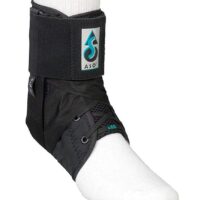
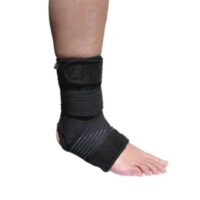
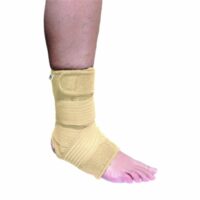
Ankle Products
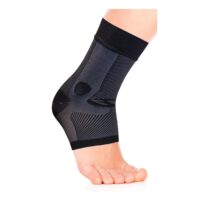
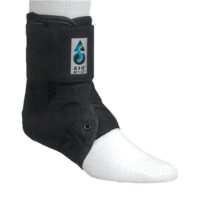
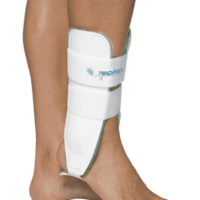
These ankle products are commonly used by our physiotherapists to improve ankle pain, strength, balance, proprioception, endurance and flexibility, plus assist home exercise programs.
-

 Ankle, Braces & Supports, Foot, Walking
Victor Moonboot 1.0 Air or No Air
$77.00 – $79.00Select optionsQuick View -

-
 Ankle, Braces & Supports, Clearance Sale
Ankle Support with Strap – OPPO 1003
$42.00Select optionsQuick View -
-
-
-
-
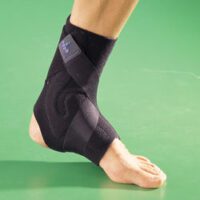 Ankle, Braces & Supports, Foot
Ankle Support with Plastic Stay – OPPO 1109
$52.00Select optionsQuick View - Liniments & Gels, Massage Liniments, Pain Management
Fisiocrem
$16.95 – $39.95Select optionsQuick View -

- EMS Machines, Pain Management, TENS Machine, TENS Machine & EMS
NeuroTrac Rehab (TENS Machine + EMS)
$299.95Add to cartQuick View -


-
-
-
-






References
- Wagemans J, Bleakley C, Taeymans J, et al. Exercise-based rehabilitation reduces reinjury following acute lateral ankle sprain: a systematic review update with meta-analysis. PLoS One. 2022;17(2):e0262023. doi:10.1371/journal.pone.0262023
- Guo Y, Cheng T, Yang Z, Huang Y, Li M, Wang T. A systematic review and meta-analysis of balance training in patients with chronic ankle instability. Systematic Reviews. 2024;13:64. doi:10.1186/s13643-024-02455-x
- Gaddi D, Mosca A, Piatti M, et al. Acute ankle sprain management: an umbrella review of systematic reviews. Front Med (Lausanne). 2022;9:868474. doi:10.3389/fmed.2022.868474
- Smith MD, Vicenzino B, Bahr R, et al. Return to sport decisions after an acute lateral ankle sprain injury: introducing the PAASS framework—an international multidisciplinary consensus. Br J Sports Med. 2021;55(22):1270–1276.
