
Rotator Cuff Exercises
Rotator Cuff Exercises


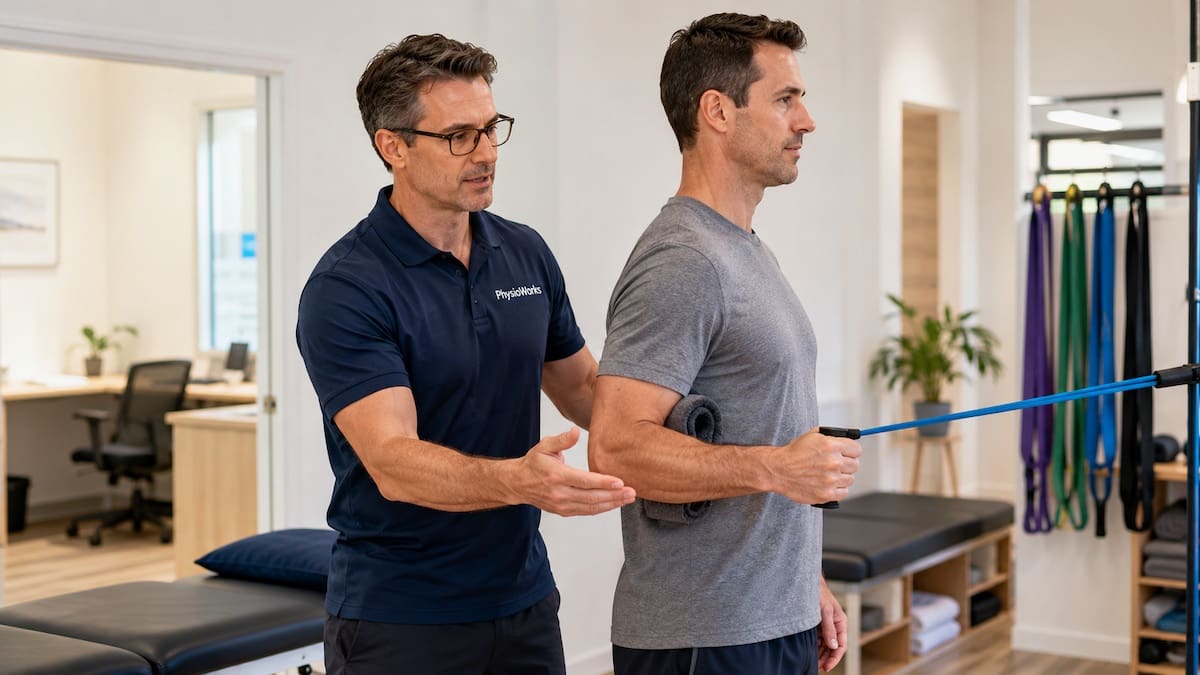
Rotator cuff exercises can help build shoulder strength, control and confidence. The right exercises depend on your symptoms, current strength, shoulder movement and the activities you want to return to.
How can rotator cuff exercises help?
Rotator cuff exercises aim to improve the strength and control of the muscles that support your shoulder. They may help with reaching, lifting, gym work, manual tasks, swimming, throwing and other overhead activities.
However, shoulder pain does not always come from the same problem. Symptoms may relate to a rotator cuff injury, rotator cuff tendinopathy, rotator cuff tear, shoulder bursitis, frozen shoulder, shoulder instability or another shoulder condition.
That matters because the most useful exercise, load and range can differ between people. Exercise should match the problem rather than relying on one standard shoulder program.
What does the rotator cuff do?
The rotator cuff is a group of four muscles and their tendons around the shoulder. Together, they help control the position of the upper arm bone while you move your arm.
Supraspinatus
Helps lift the arm and contributes to shoulder control during reaching and loading.
Subscapularis
Helps turn the arm inward and supports control at the front of the shoulder.
Infraspinatus and teres minor
Help turn the arm outward and support control at the back of the shoulder.
Your shoulder blade also contributes to efficient arm movement. For this reason, rotator cuff rehabilitation often includes shoulder blade exercises as well as direct rotator cuff strengthening.
Your physiotherapist may also assess your scapulohumeral rhythm, which describes how the upper arm and shoulder blade work together as you raise your arm.
Do rotator cuff exercises help shoulder pain?
Exercise is an important part of rehabilitation for many people with rotator cuff-related shoulder pain. However, research does not support one universal exercise program that is best for everyone.
The useful starting point depends on factors such as pain, strength, range of movement, irritability and the loads your shoulder needs to handle. A program may then progress as your shoulder tolerates more work.
If an exercise repeatedly causes a substantial flare, the answer is not always to stop exercising. Changing the resistance, range, position, speed, repetitions or recovery time may make the exercise more appropriate.
How hard should rotator cuff exercises feel?
A useful exercise should feel controlled and achievable. Some people can exercise comfortably with no pain. Others can tolerate a mild shoulder ache while strengthening.
Sharp pain, sudden catching, a clear loss of strength or symptoms that keep escalating are reasons to change the exercise and consider assessment.
Also check your response after the session. If your shoulder becomes progressively more irritable or your usual activities are noticeably worse afterwards, reduce the exercise load rather than automatically pushing through.
How should you start rotator cuff exercises?
-
Find a manageable starting load
Choose a resistance, position and range that allow controlled movement. Early exercises do not need to feel heavy to be useful.
-
Keep the movement controlled
Avoid rushing through repetitions. Keep the shoulder, elbow and shoulder blade in the position required for the exercise.
-
Check the response afterwards
Consider how your shoulder feels later that day and with normal activities. Persistent aggravation usually means the current dose needs adjusting.
-
Progress one variable at a time
Increase resistance, repetitions, range, speed or task difficulty gradually rather than changing everything at once.
Why does shoulder blade control matter?
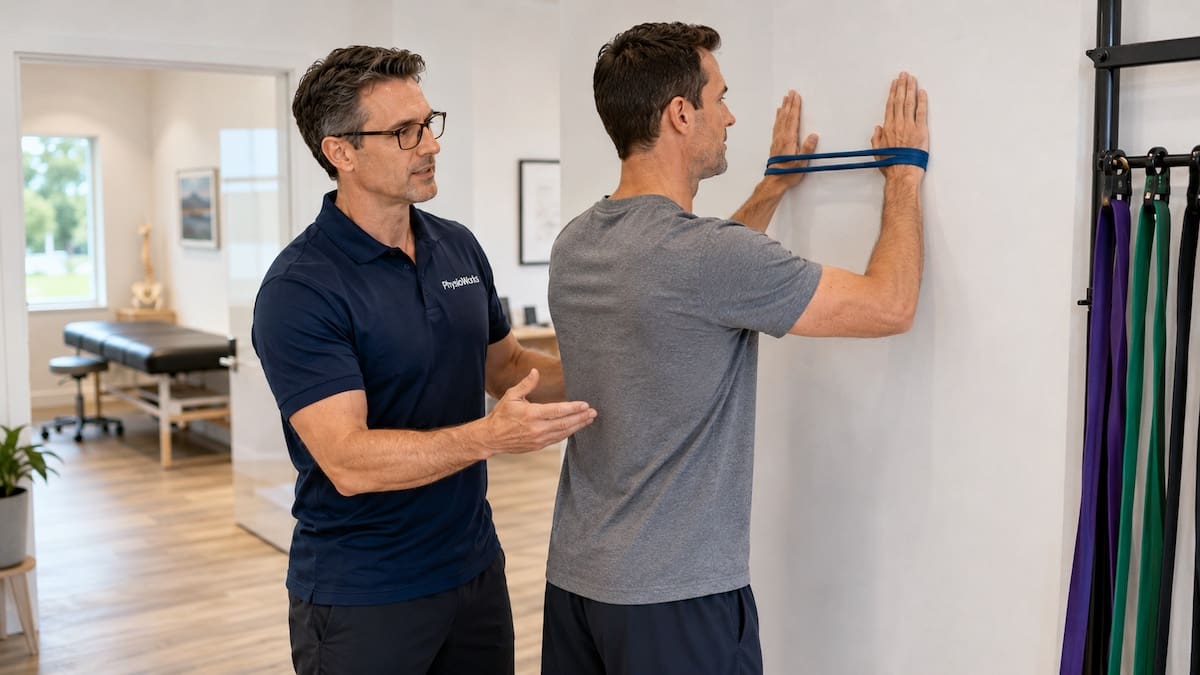
Your rotator cuff does not work in isolation. Muscles around the shoulder blade help position the shoulder so your arm can move efficiently.
Rows, wall slides and other scapular stabilisation exercises may therefore form part of a broader shoulder rehabilitation program.
How do rotator cuff exercises progress?
Rotator cuff rehabilitation usually becomes more demanding as strength, movement and load tolerance improve. Progression should reflect what you need your shoulder to do rather than simply moving to a stronger resistance band.
-
Build early control
Start with manageable muscle holds, light resistance and comfortable movement when these suit your presentation.
-
Build strength through useful ranges
Progress resistance exercises, arm raises, rows and shoulder blade control as your shoulder tolerates more load.
-
Add functional strength
Introduce pushing, pulling, lifting, carrying or overhead tasks that reflect your work, home or gym demands.
-
Prepare for higher-level activity
Sport and physically demanding work may require faster movement, greater resistance, repeated overhead loading or task-specific rehabilitation.
What are common rotator cuff exercise mistakes?
- Using a generic program without considering the cause of your shoulder symptoms.
- Starting with more resistance or range than you can control.
- Pushing repeatedly through sharp pain or worsening weakness.
- Doing many similar exercises without a clear purpose.
- Progressing load, volume and range at the same time.
- Ignoring shoulder blade strength and movement when these are relevant.
- Stopping all shoulder loading for long periods without a clinical reason.
- Returning to heavy overhead work or sport before building enough capacity for that task.
When should you get your shoulder checked?
Consider a physiotherapy assessment when shoulder pain is persistent, repeatedly limits normal activity, interferes with sleep or is not responding to a sensible exercise program.
Increasing weakness, major loss of movement, recurrent instability or symptoms that continue to worsen are also reasons to seek individual advice rather than simply adding more exercises.
What if you have a rotator cuff tear?
A rotator cuff tear does not automatically mean you should avoid exercise. Rehabilitation can form part of non-surgical management for some tears and is also important around surgical care when appropriate.
However, tear size, injury mechanism, age, function, weakness, activity demands and other shoulder findings can affect the management plan. Exercises for a significant tear therefore should not be assumed to be the same as exercises for uncomplicated rotator cuff-related shoulder pain.
What if you have had rotator cuff surgery?
Follow the rehabilitation plan provided by your surgeon and physiotherapist after rotator cuff repair. Post-operative loading and movement restrictions depend on the procedure, tissue healing and stage of recovery.
Do not use a general online rotator cuff program to override post-operative precautions.
How do exercises progress towards work, gym or sport?
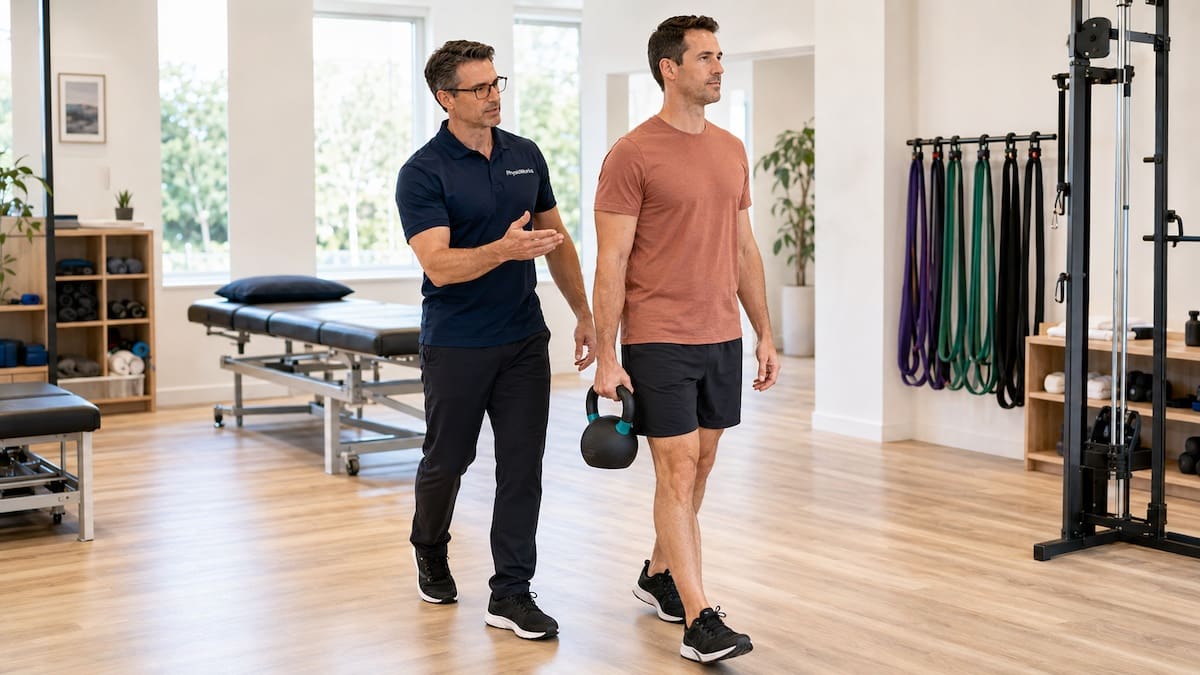
Later rehabilitation should prepare your shoulder for the loads that matter to you. A desk worker, carpenter, swimmer, tennis player and gym participant may therefore need different progressions.
These may include heavier resistance, loaded carries, overhead control, pushing and pulling, faster movements or graded throwing. People returning to sport may also benefit from broader sports physiotherapy planning.
What does current research say?
Current clinical guidelines support active rehabilitation as an important part of care for rotator cuff tendinopathy and other rotator cuff-related presentations. Exercise selection and progression should be individualised rather than based on one supposedly superior program.
Research comparing different exercise approaches also shows uncertainty about the ideal type, intensity and dosage. This supports matching exercise to the person, monitoring the response and progressing towards meaningful activities.
For rotator cuff tears and broader rotator cuff injuries, management may involve non-surgical or surgical pathways depending on the individual presentation. The American Academy of Orthopaedic Surgeons rotator cuff guideline provides further evidence-based guidance.
Rotator Cuff Exercises FAQs
What are the best rotator cuff exercises?
There is no single best rotator cuff exercise for everyone. Common options include resisted outward rotation, side-lying rotation, rows, wall slides and controlled arm raises. The best choice depends on your symptoms, strength, movement and goals.
How often should I do rotator cuff exercises?
Exercise frequency depends on the exercise and the load. Light movement or control exercises may suit more frequent practice, while harder strengthening usually needs enough recovery between sessions. Adjust the program if your shoulder becomes progressively more irritated.
Should rotator cuff exercises hurt?
Rotator cuff exercises do not need to be completely pain-free for everyone, but they should remain controlled. Mild discomfort may be acceptable in some programs. Sharp pain, worsening weakness or a substantial symptom flare means the exercise or load should be reviewed.
Can I do rotator cuff exercises with a tear?
Exercise can form part of treatment for some rotator cuff tears, but the right program depends on the tear, your strength, symptoms, function and treatment plan. Sudden or substantial weakness after an injury should be assessed before relying on a general exercise program.
How long do rotator cuff exercises take to work?
There is no fixed recovery time. Changes in pain, confidence, strength and function can occur at different rates, and meaningful strength gains usually require consistent training over time. Your starting condition, exercise load, recovery and activity demands all influence progress.
When should I see a physiotherapist for rotator cuff pain?
Consider a physiotherapy assessment if shoulder pain keeps limiting sleep, work, exercise or daily activity, if weakness is increasing, or if a sensible exercise program is not helping. Seek assessment sooner after a significant injury with sudden weakness or loss of arm function.
What to do next
If your shoulder is mildly sore but functioning reasonably well, start with a small number of exercises you can control. Monitor how your shoulder responds and increase the challenge gradually.
If pain, weakness or restricted movement is making it difficult to choose or progress your exercises, a physiotherapist can assess your shoulder and help match rehabilitation to your presentation and goals.
You can also explore the broader shoulder exercise guide or learn more about common causes of shoulder pain.
Choose your clinic and appointment pathway
Select a PhysioWorks clinic to continue to live booking, an appointment request or reception assistance.
Shoulder Products
These shoulder products are commonly used by our physiotherapists to improve strength, posture, movement, plus assist home exercise programs.
- Liniments & Gels, Massage Liniments, Pain Management
Fisiocrem
$16.95 – $39.95Select optionsQuick View -
-
-
-
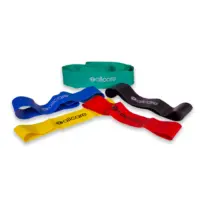
 Exercise Equipment, Knee, Resistance Band
POW.R Fabric Mini Loop Bands
$12.00 – $55.00Select optionsQuick View -
-
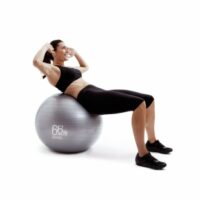 Exercise Balls, Back, Exercise Equipment, Knee, Shoulder
66fit Exercise Balls | Core & Rehab Stability Ball
$32.00 – $57.00Select optionsQuick View -
-

-

-
-

-
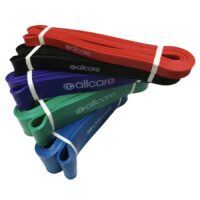
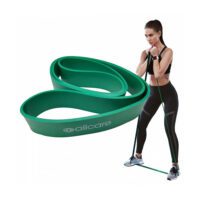 Exercise Equipment, Resistance Band
AllCare Powerloop Bands
$22.00 – $65.00Select optionsQuick View -

- EMS Machines, Pain Management, TENS Machine, TENS Machine & EMS
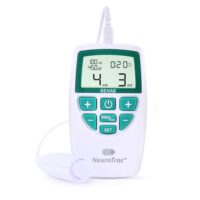
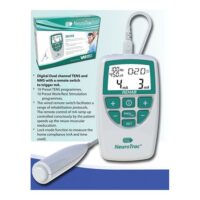
NeuroTrac Rehab (TENS Machine + EMS)
$299.95Add to cartQuick View

References
- Desmeules F, et al. Rotator cuff tendinopathy diagnosis, nonsurgical medical care, and rehabilitation: a clinical practice guideline. J Orthop Sports Phys Ther. 2025.
- Lafrance S, et al. The efficacy of exercise therapy for rotator cuff-related shoulder pain: a systematic review. 2024.
- Zhong Z, Zang W, Tang Z, Pan Q, Yang Z, Chen B. Effect of scapular stabilization exercises on subacromial pain syndrome: a systematic review and meta-analysis of randomized controlled trials. Front Neurol. 2024;15:1357763.
- American Academy of Orthopaedic Surgeons. Management of Rotator Cuff Injuries: Evidence-Based Clinical Practice Guideline. Published August 18, 2025.
